Features in the nele.ai chat
When you hover over a chat message, additional features and processing options appear. These vary depending on whether the message is from the user or the AI.
Feature overviewFeature overview
Opening the context menuThe following functions are available
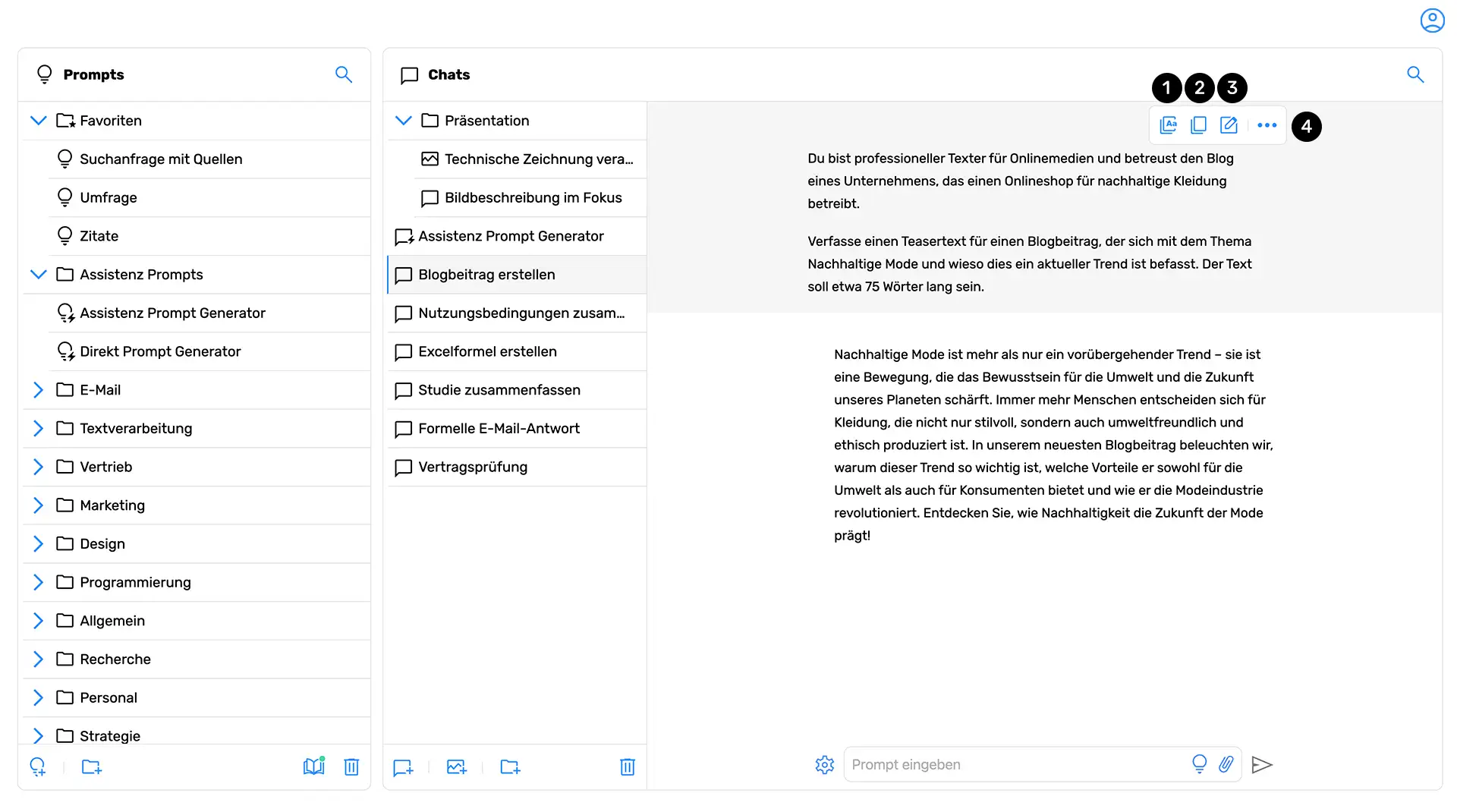
Hover your mouse over one of your chat messages or an AI chat message. A context menu will then appear at the top of the message. On mobile devices, tap the permanently displayed three-dot menu to open the context menu.Move the mouse over one of your chat messages or over a chat message from the AI. A context menu is then displayed at the top of the message. On mobile devices, click on the permanently displayed three-dot menu to open the context menu.
The context menu for user messages includes three features: “Copy message content with formatting” (1), “Copy message content” (2), and “Edit message” (3).The context menu for the user's messages comprises the three functions “Copy message content with formatting” , “Copy message content” and “Edit message”
The “Edit message” option (3) is only available for prompts entered by the user, not for AI responses. This feature allows you to modify text you have already sent. Please note that if you modify one of your messages in the middle of a conversation, the subsequent existing conversation history will change.The “Edit message” option is only available for prompts entered by the user and not for AI answers. With this function, you can subsequently adjust the text you have already sent. Note that if you adjust one of your messages in the middle of a call, the subsequent, existing conversation history will change.
Click the three dots (4) in the context menu to open the advanced context menu. Additional features are available here.In the context menu, click on the three dots to open the extended context menu. Additional functions are available here.
Advanced context menuEdit and reuse user inputs
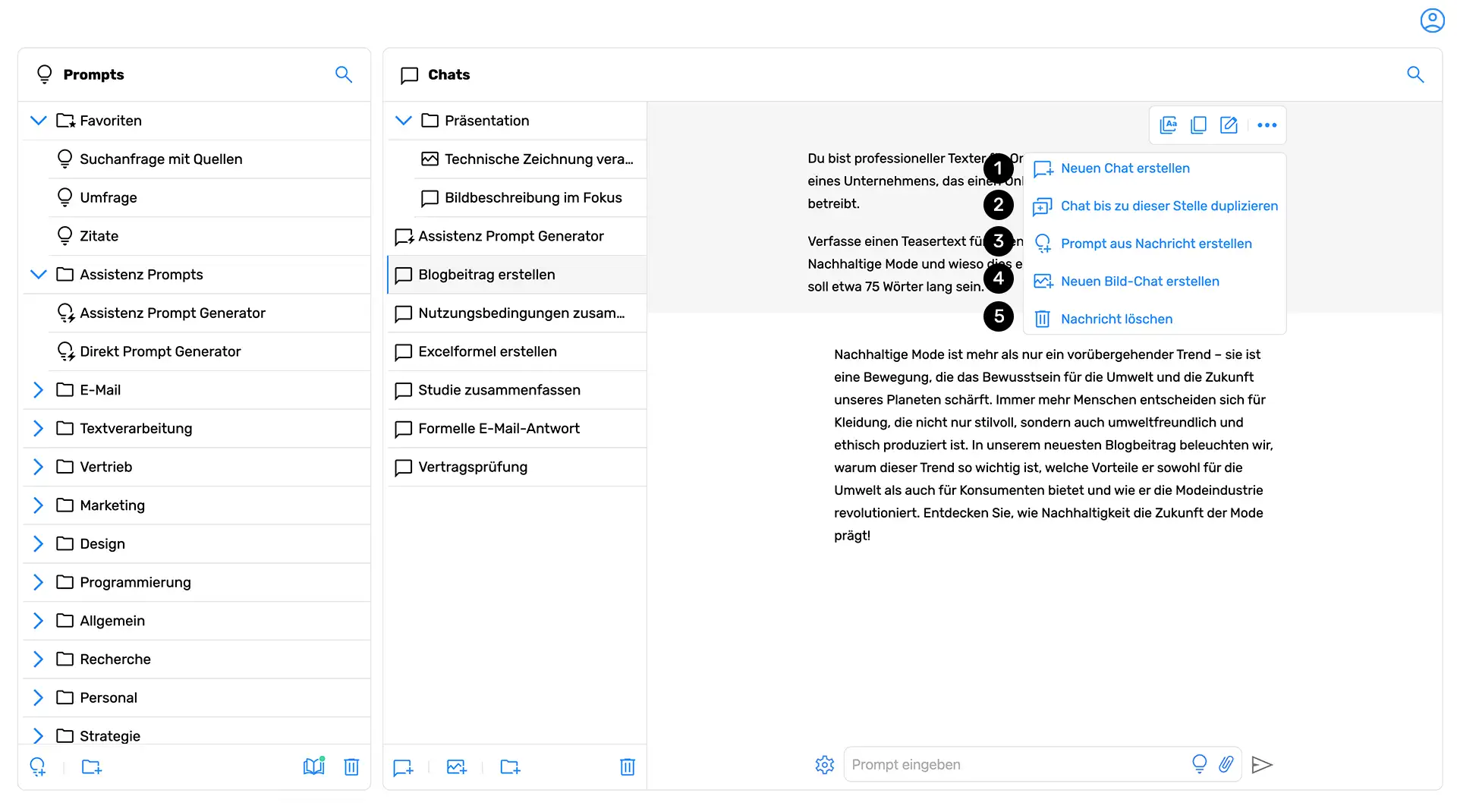
The “Create new chat” button (1) starts a separate chat using the selected message as the starting point. The previous conversation history is not carried over.Using the “Create a new chat” button Start a separate chat that uses the selected message as the starting point for the new chat. The previous conversation history is not transferred.
The second button, “Duplicate chat from this point,” creates a “fork” (2), where the entire chat history up to that point is carried over into a new chat. It is essentially the counterpart to the “Create new chat” feature (1), which uses the chat message as a starting point for a new chat without carrying over the previous history. When a fork is created, any documents and websites linked in the chat up to that point are also included in the new chat.The second button, “Duplicate chat to this point,” creates a so-called “fork” , in which the entire chat history up to this point is transferred to a new chat. It is therefore virtually the counterpart of the function , “Create a new chat,” which sets the chat message as the starting point for a new chat, but without inheriting the previous chat history. If a fork is created, documents and websites integrated into the chat up to this point are also transferred to the new chat.
The third button, “Create prompt from message” (3), converts the message content into a standalone prompt that you can save in your prompt tree. Please note that this feature is only available for user messages, not for AI responses. You can find more details on prompt creation in this manual articlethis manual article.With the third button, “Create Prompt from Message” , transfer the content of the message to a separate prompt, which you can save in your prompt tree. Note that this feature is only available for user messages, not for answers from AI. For more information about creating prompts, see
The “Create new image chat” button (4) opens a new image chat, using the selected message as the starting point. This feature is only available if you are using a compatible image-processing AI model or have been granted access by your administrator. An overview of models capable of generating and processing images can be found in this separate manual articlethis separate manual article.With the “Create new image chat” button Can a new image chat be opened, in which the selected message is transferred to this chat as a starting point. This function is only available if you use an appropriate image processing AI model or have been approved for it by your administrator. An overview of models that can generate and process images can be found in
You can also delete a chat message (5). In this case, not only that message but the entire subsequent chat will be deleted.You can also delete a chat message . In this case, not only this message but the entire subsequent chat will be deleted.
Please note that while all features mentioned here are available for user messages, some are not available for AI messages, such as “Create prompt from message” and “Edit message.” Conversely, there are features that can only be used for AI responses. Learn more about this in the following section.Note that all features mentioned here are available for user messages, but not all for AI messages. These include “Create Prompt from Message” and “Edit Message.” At the same time, there are functions that can only be used for AI answers. Read more about this in the following section.
“Regenerate chat” feature for AI messages“Repeat chat” feature for AI messages
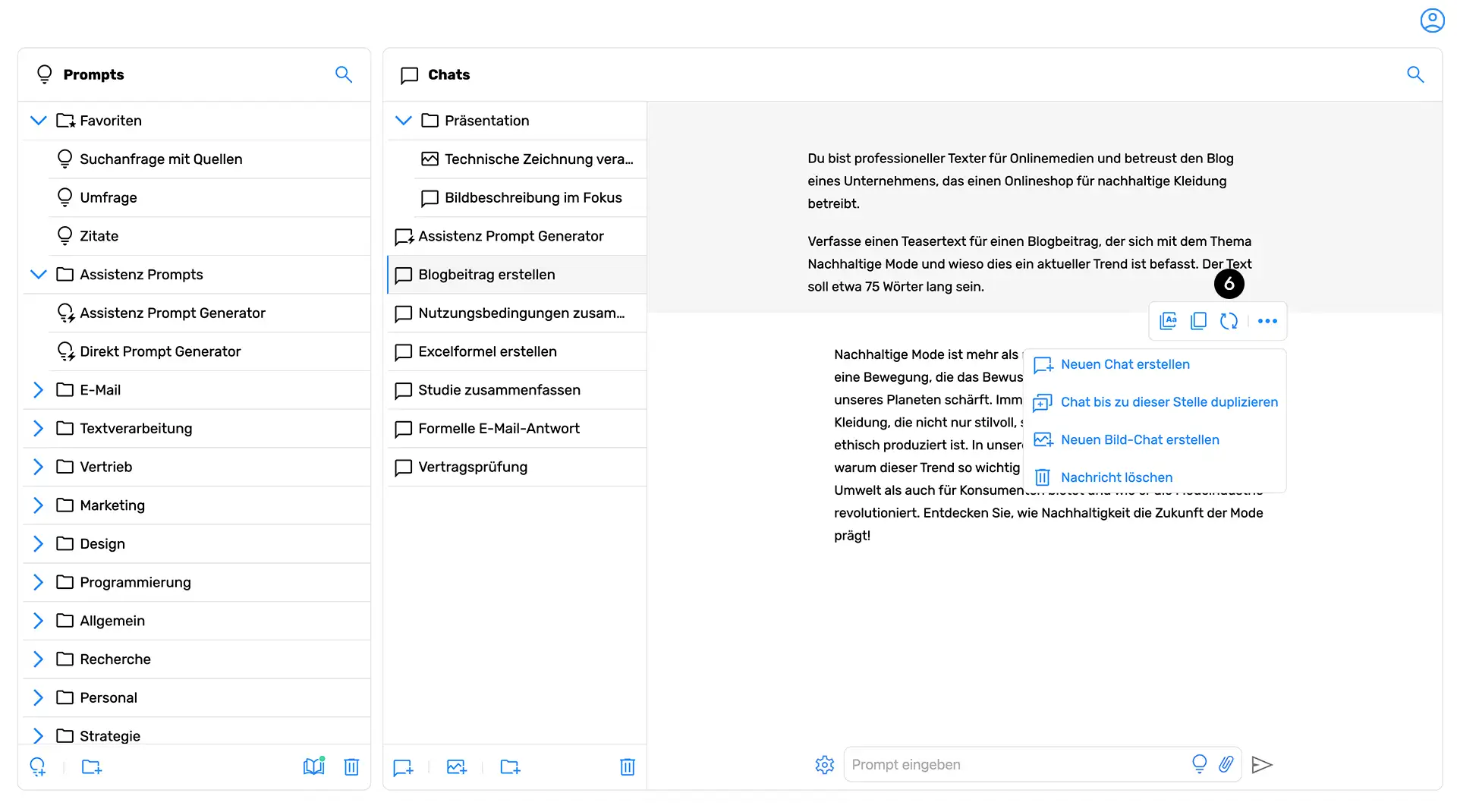
This feature is available exclusively for AI responses. Click the corresponding icon on the message (6) to regenerate it. The previous response will be discarded, and the AI will generate a new one based on the last prompt you entered before that response.This function is only available for answers from AI. Click on the corresponding icon on the message to have them generated again. In doing so, the old answer is rejected. The AI will then answer you again, referring to the last prompt that you entered before this answer.