Set up SSO with nele.ai
Setting up SSO and member settings
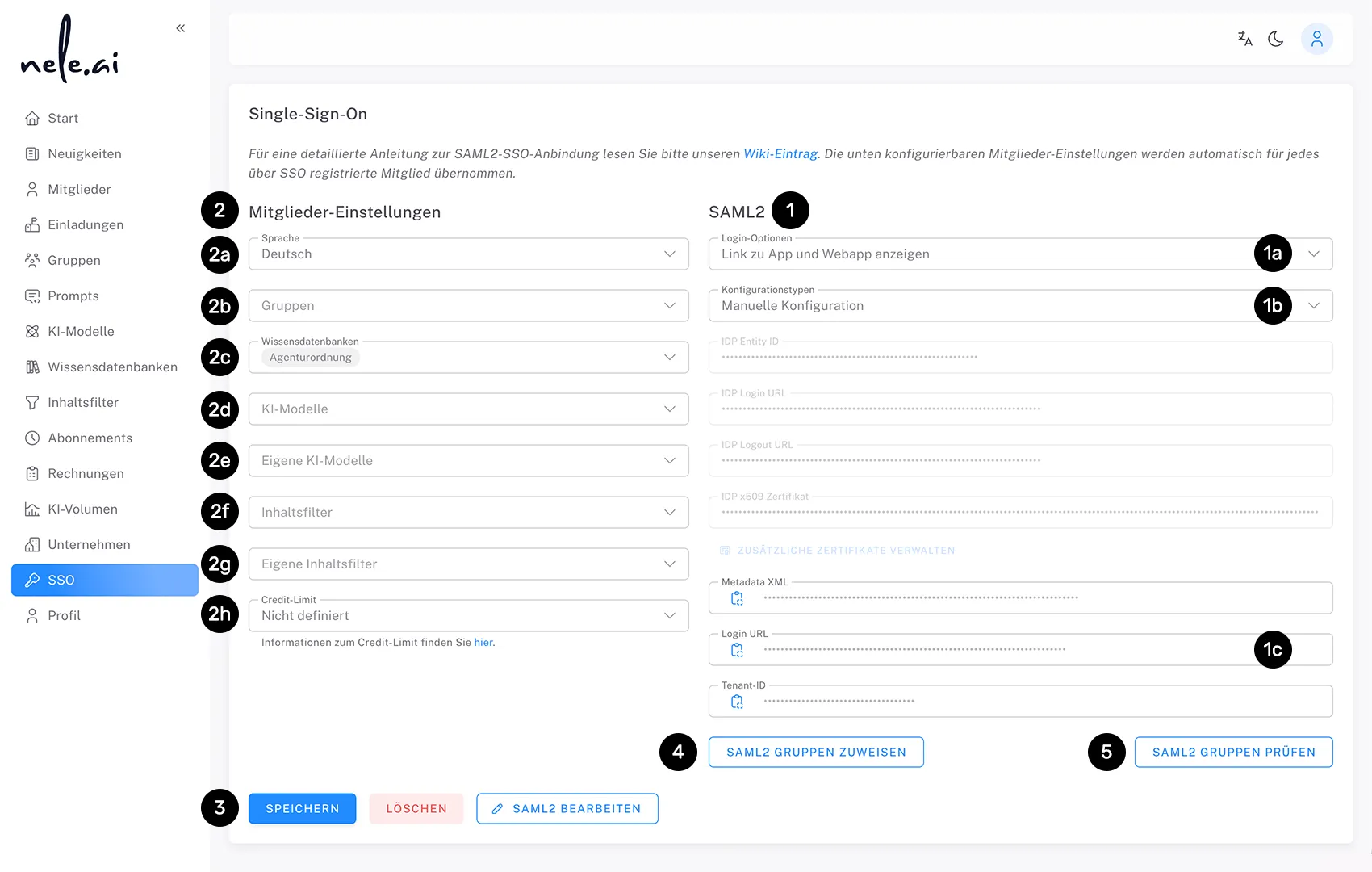
Follow the steps to set up your SSO connection by filling in the required fields with your SSO provider information. For detailed instructions on SAML2 SSO integration, please read the manual entry on configuring via Microsoft Entra ID or ADFS.
You can set a global redirect here for where members should be sent after a successful login. To do this, select from the "Login Options" (1a) dropdown menu: "Show link to app and web app," "Direct redirect to chat.nele.ai," "Show link to app," or "Show link to web app only."
You have three options below to configure your SSO settings (1b). Please choose from the following:
Manual configuration
Enter the appropriate values into the corresponding fields below.
Configure via Metadata XML file
Import values via an external file.
Configure via Metadata XML URL
Recommended configuration type, as this allows your data to be updated even after the validity period has expired.
You can copy the login URL (1c) using the icon next to the input field and share it with your company's members. Team members can use this URL to log in to their nele.ai accounts via SSO in the future.
Once the general SSO setup is complete, you can define member settings, known as defaults (2). These include their language (2a), assigned groups (2b), assigned knowledge bases (2c), assigned AI models (2d), assigned custom AI models (2e), assigned content filters (2f), assigned custom content filters (2g), and the monthly credit limit (2h) to be made available.
These are the default settings that members are automatically assigned when they log in to nele.ai for the first time via SSO links.
Additionally, you can create various SAML2 groups in the SSO section, which are then assigned directly to members upon login via the specified SAML2 connection (4).
Finally, click "Save" (3) to enable access to nele.ai via SSO or to save your member settings.
Adjusting user settings
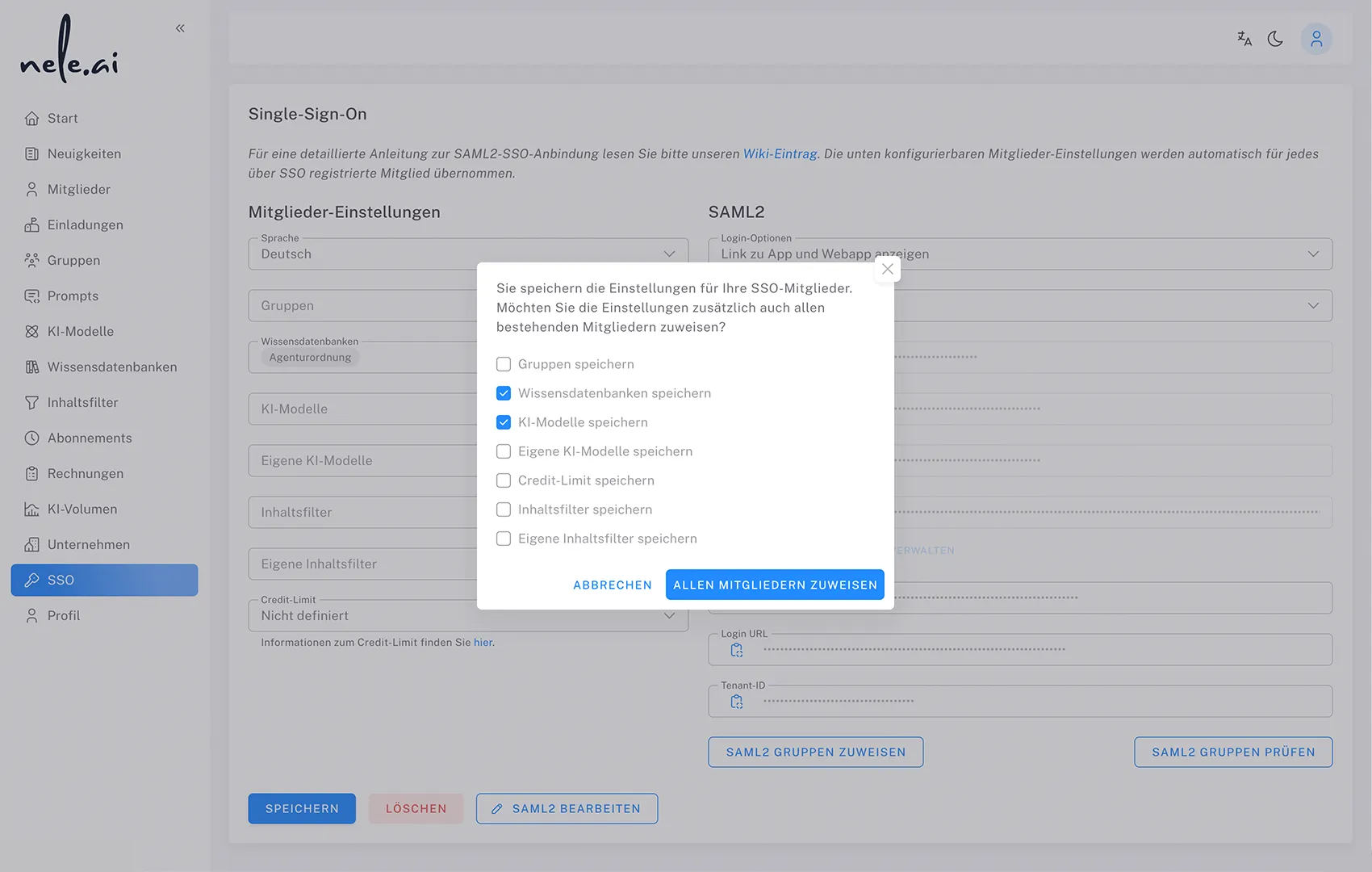
You can adjust member settings in the SSO section at any time. If you change one or more of your previously set values, you will have the following additional option:
After clicking the save button, an overlay will list the adjustments you have made. Select the checkbox to the left of the respective entries to apply your changes globally to all existing and future members. If the checkbox is left empty, your adjustment will only apply to future members, not existing ones.
Please note that you need both SSO and member management permissions to use this feature. If you only have SSO permissions, adjustments to member settings will only apply to future members, not existing ones, and the overlay described will not appear.
Further individual settings for existing members can be adjusted at any time at https://manage.nele.ai/users.
Click "Assign to all members" to apply your changes.
Configure SAML2 group assignments
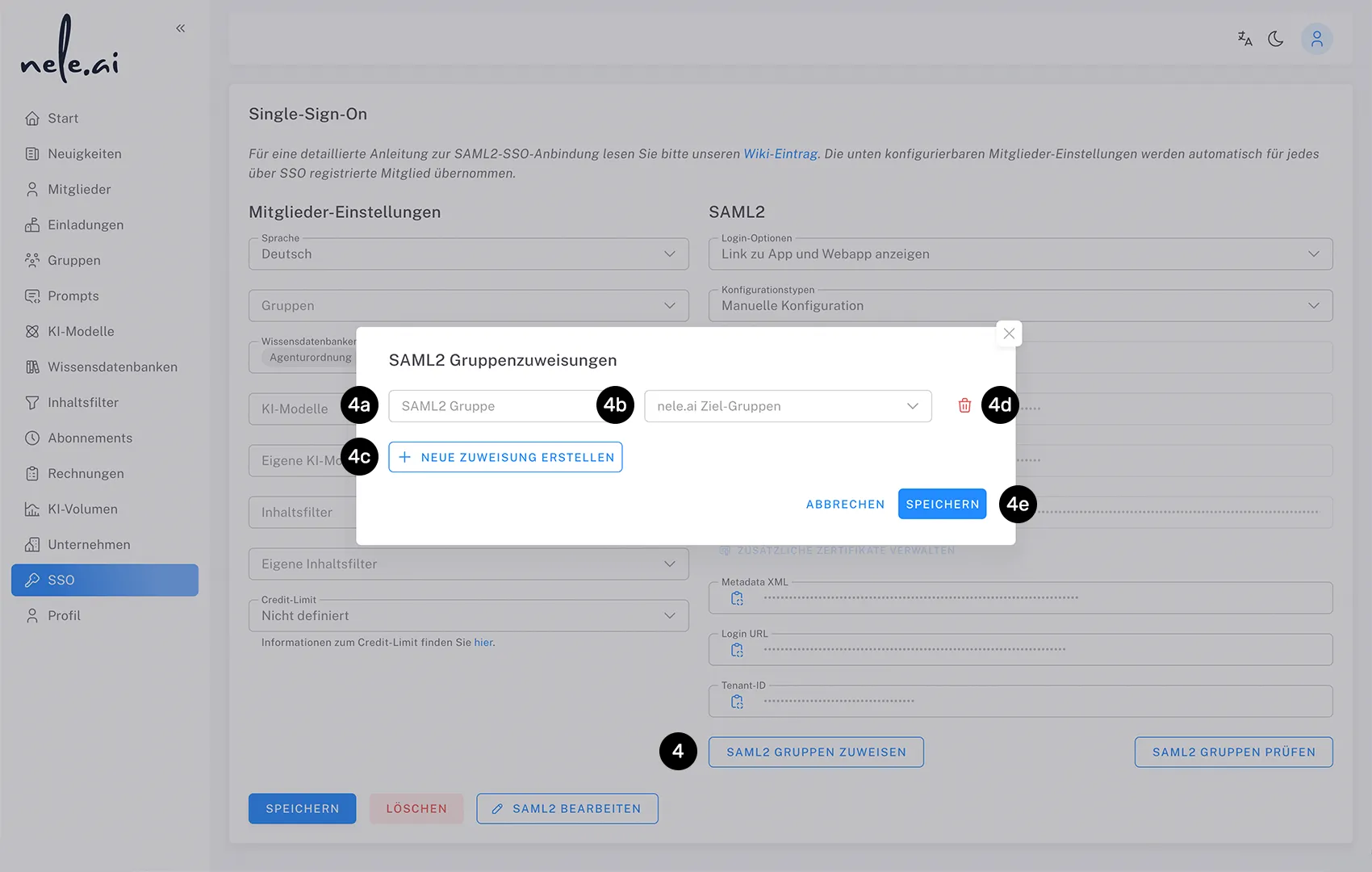
In the SSO section, you can create various SAML2 groups, which will then be directly assigned to members upon login via the specified SAML2 connection.
Click "Assign SAML2 groups" (4) to open the group assignment overlay. Here, you can map existing SAML2 groups to nele.ai groups.
In the "SAML2 Group" input field (4a), enter the name of the SAML2 group exactly as it is transmitted by your Identity Provider. In the "nele.ai target groups" dropdown menu (4b), select the corresponding target group in nele.ai to which members should be automatically assigned.
You can add further group assignments using "Create new assignment" (4c). Existing assignments can be removed using the trash icon (4d).
Finally, click "Save" (4e) to activate your group assignments.
Check SAML2 group assignments
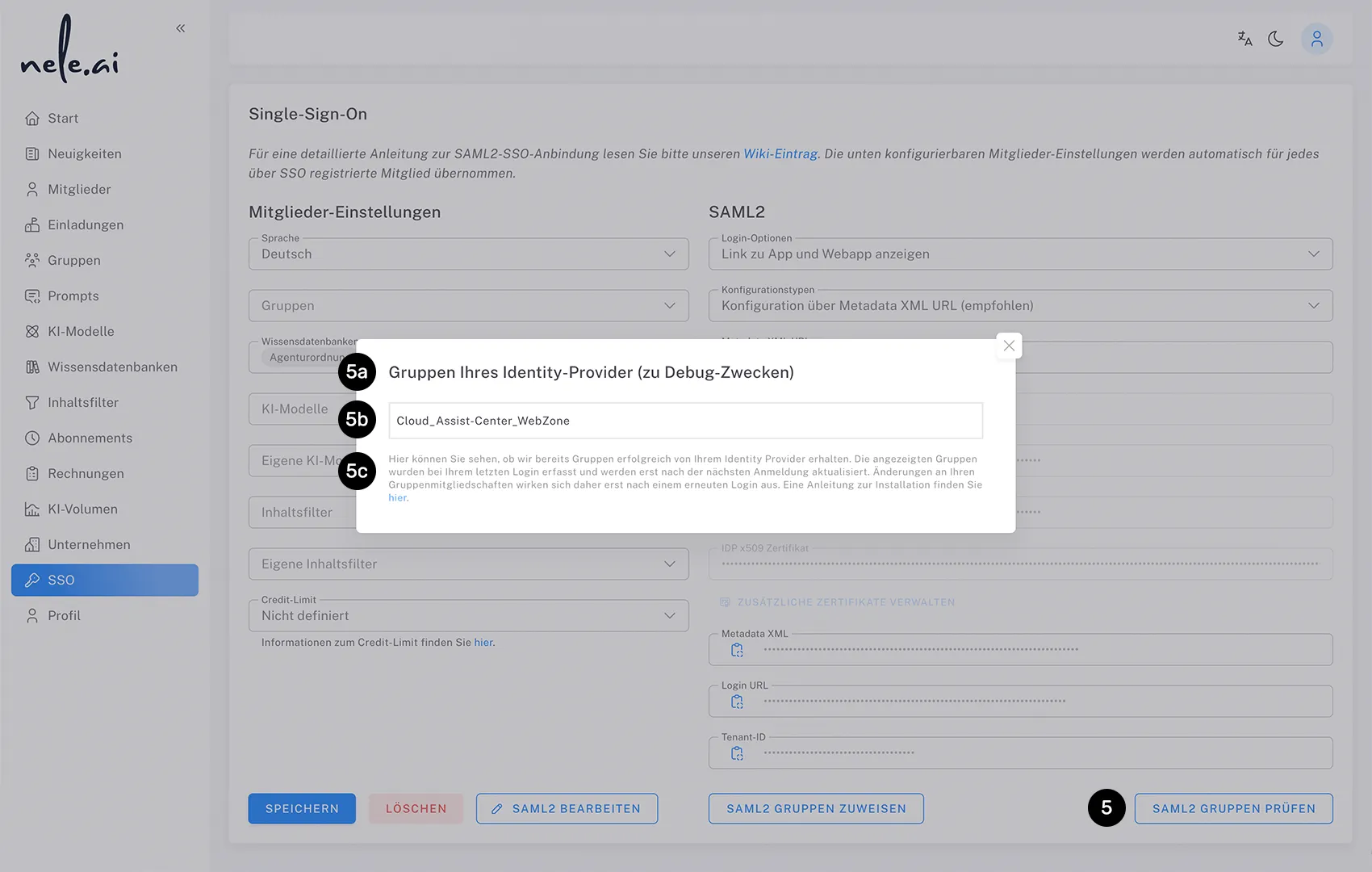
To ensure that your SAML2 configuration is set up correctly and that group information is being transmitted by your Identity Provider as expected, you can use the "Check SAML2 Groups" button (5). This opens a debug overlay that shows you which groups are currently recognized by your Identity Provider.
In the upper area of the overlay (5a), you will see the title "Identity Provider Groups (for debugging purposes)." Below this, the current status of the detected groups is displayed (5b) – if no successful group transfer has occurred yet, the message "No Identity Provider groups available" will appear here. As soon as your SAML2 connection is correctly configured and group data is being transmitted, this area will list the actually detected groups instead.
The explanatory text (5c) notes that the displayed groups correspond to the last successful login and that changes to group memberships only take effect after logging in again. You can access detailed installation instructions via the linked note within the overlay.
You can close the overlay using the close icon (5d) in the top right corner.