Manage your team's AI models
Overview of AI modelsOverview of AI models
Here you can select available AI models for your company.Here you can select available AI models for your company.
AI models differ in various aspects, such as the AI volume consumption factor or response speed. Certain AI models also support image processing. Regardless of the server location of your chosen AI model, the entire application complies with GDPR requirements.The AI models differ in various aspects, such as the consumption factor of the AI volume or the speed of response. Certain AI models also support image processing. Regardless of the server location of your chosen AI model, the entire application meets the requirements of the GDPR.
Filter AI modelsFilter AI models
Above the model table, you will find filter functions that allow you to quickly find suitable AI models. The filters are permanently displayed in two rows and become active immediately upon selection.Filter functions are available above the model table, with which you can quickly find suitable AI models. The filters are displayed permanently in two lines and are active immediately after selection.
Available filter options:Available filter options:
- ModalityModality: Filter by language models, image models, or audio models
- Model familyModel family: Select specific model series such as GPT, Claude, Gemini, or Mistral
- SupportedAssisted: Filter by features such as assistant prompts or image recognition
- Reasoning: Show only models with advanced reasoning capabilities
- Server locationServer location: Filter by server geographic location
- Consumption factorConsumption factor: Sort by AI volume consumption
Most filters are designed for single selection; only the "Supported" filter allows for multiple selections. You can remove active filters individually in their respective input fields or all at once using the "Reset filters" button.Most filters are designed as single select, only the “Supported” filter allows multiple selections. You can remove active filters individually in the respective input fields or collectively using the “Reset filter” button.
Note:Note: Custom AI models are currently not captured by the filters. The filters do not currently cover your own AI models.
Difference between language, image, and audio modelsDifference between voice, image, and audio models
- Language modelsLanguage models: These models are optimized for processing and generating text. They are suitable for tasks such as writing documents, answering questions, summarizing, or translating. Most current language models also support image recognition.
- Image modelsImage models: Specialized models for generating or editing images. They are used when visual content needs to be created or analyzed.
- Audio modelsAudio models: These models process spoken language and can be used for transcription, speech recognition, or text-to-speech conversion.

Activate an AI model by checking the box on the left next to the model's title (1).Activate an AI model by ticking the box on the left side next to the model's title
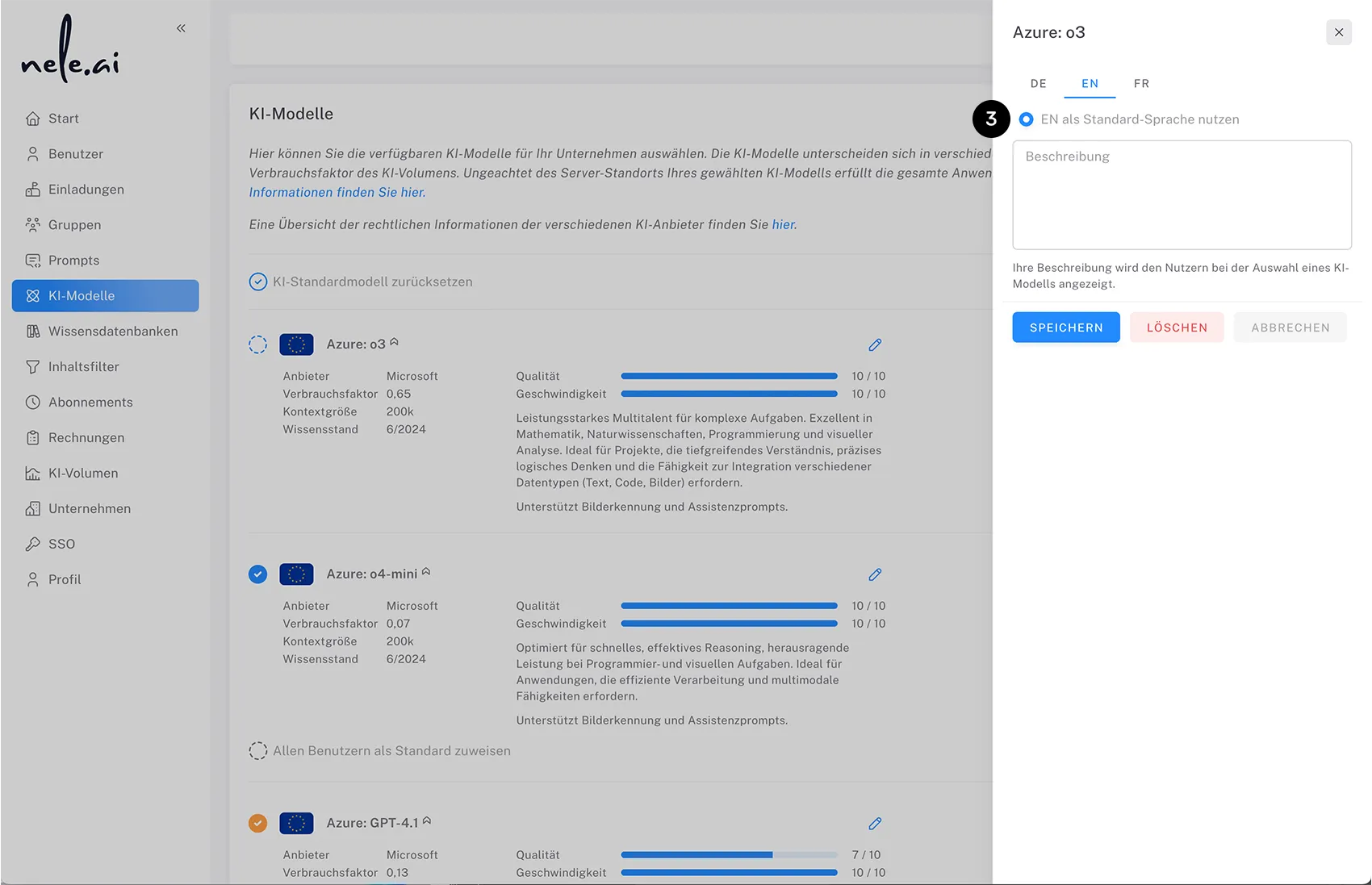
Additionally, you can provide custom descriptions for each AI model in various languages. Click the pencil icon (2) next to the respective model to open the sidebar with the description options. In the sidebar, you can set a default language (3) and manage descriptions in different languages. The description will be displayed to members in their preferred language if available; otherwise, the default language will be used.In addition, you can store your own descriptions in different languages for each AI model. To do this, click on the pencil icon next to the respective model to open the sidebar with the description options. In the sidebar, you can select a standard language define and maintain descriptions in various languages. The description is shown to users in their preferred language, if available, otherwise the default language is used.

When activating a model, you can decide whether to make it available exclusively to your company (via the "Publish model" button) or to assign it directly to members, groups, and/or knowledge bases (4). A model that has been published but not yet assigned is marked with an orange icon (5). For a model that is both published and assigned, the icon is blue (6).When activating, you can decide whether you want to make the model available exclusively for your company (“Publish model” button) or assign it directly to users, groups and/or knowledge databases . A published model that has not yet been assigned is marked with an orange icon . On a published and assigned model, the icon is colored blue
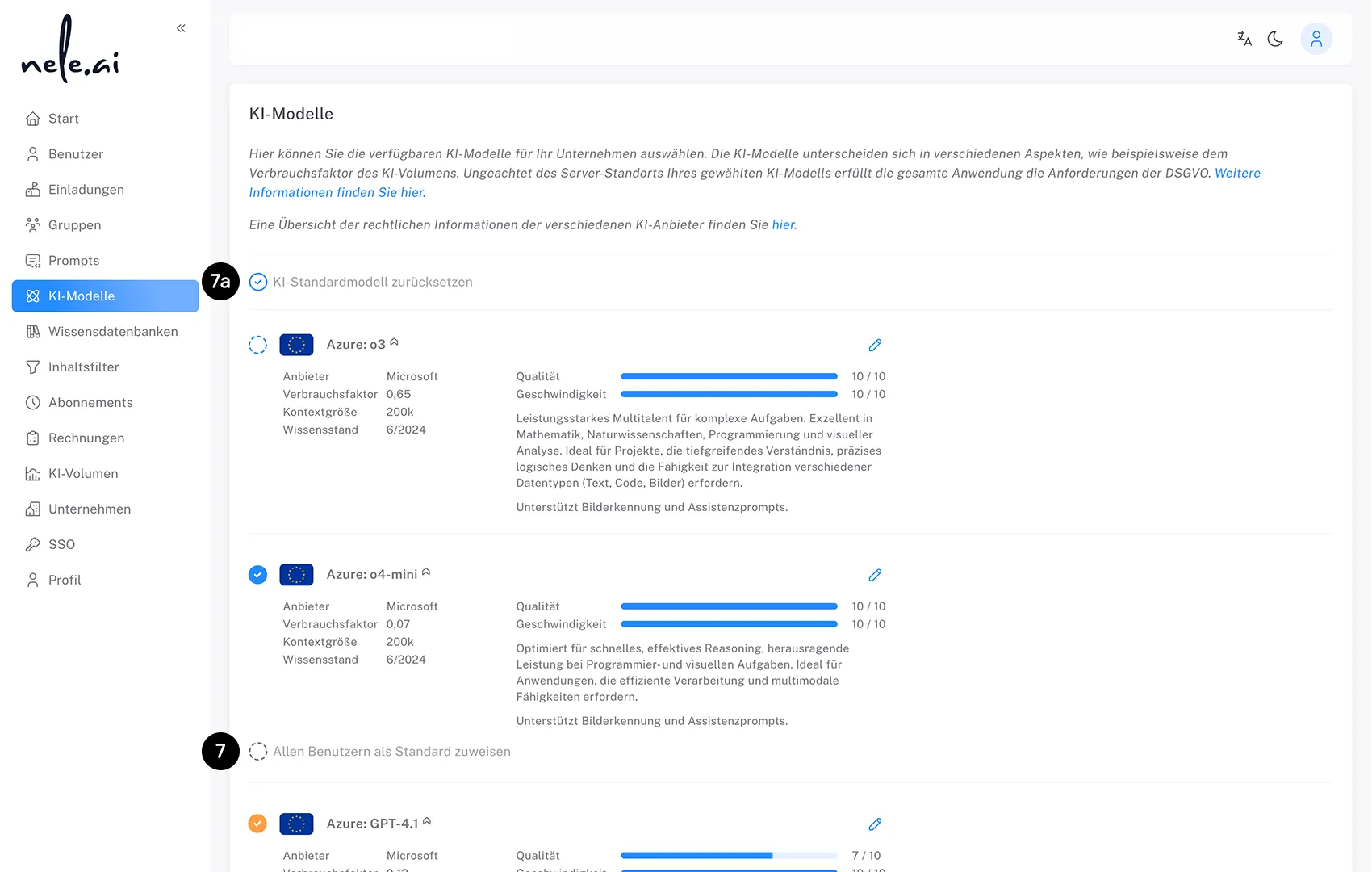
You can also determine which of the AI models shown here should be preselected as the default for your members. To do this, click the "Assign as default for all members" checkbox next to the corresponding model (7). For this option to be visible, the associated model must be published or assigned to members or knowledge bases.You can also determine which of the AI models shown here should be pre-selected as the standard model for your users. To do this, click on the “Assign all users as default” checkbox on the corresponding model . For this option to be visible, the associated model must be published or assigned to users or knowledge bases.
The default model assignment only applies to members who have not yet set their own default model in their personal settings. If a member has already chosen an individual default model, it will not be overwritten.
The assignment of the standard model is only valid for users who have not yet defined their own standard model in their personal settings. If a user has already selected an individual standard model, this is not overwritten.
To reset the default AI model, select the "Reset default AI model" checkbox at the very top of the AI model list (7a). Once done, no model will be predefined as the default for members.If you want to reset the standard AI model, select the “Reset AI standard model” checkbox at the top of the list of all AI models . As a result, no model is predefined as a standard for users anymore.
Create custom AI modelsBuild your own AI models
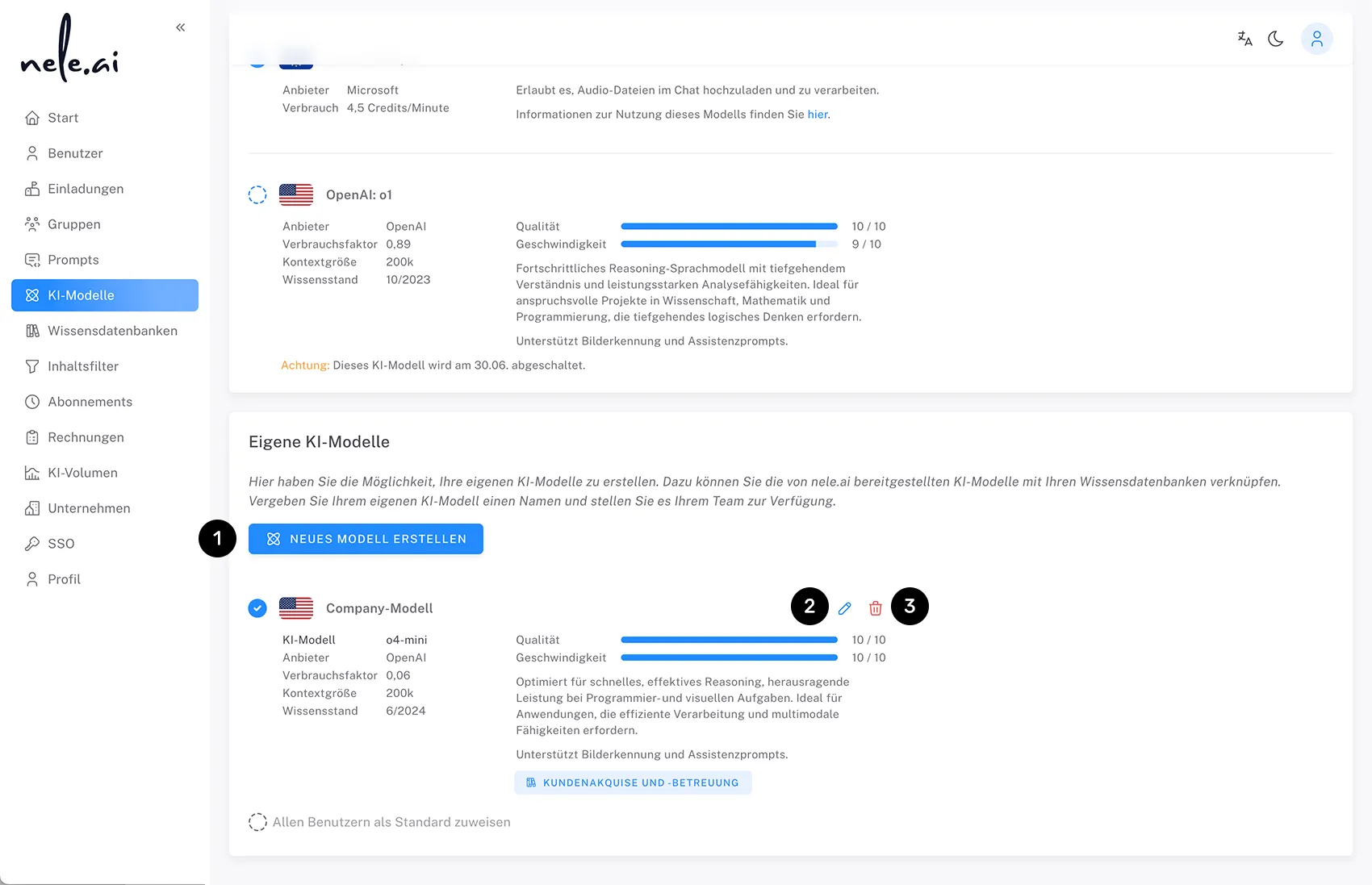
In addition to selecting existing AI models, you have the option to create your own custom AI models. This allows you to link the AI models provided by nele.ai with your own knowledge bases. To do this, scroll to the very bottom of the list of all AI models and click the "Create new model" button (1).In addition to selecting existing AI models, you have the option to create your own AI models. In doing so, you link the AI models provided by nele.ai to your knowledge databases. To do this, scroll down to the bottom of the list of all AI models and click on the “Create new model” button
If custom models have already been created, you can edit them using the pencil icon (2) or delete them via the trash icon (3).
If your own models have already been created before, you can edit them with the pencil icon or delete via the trash
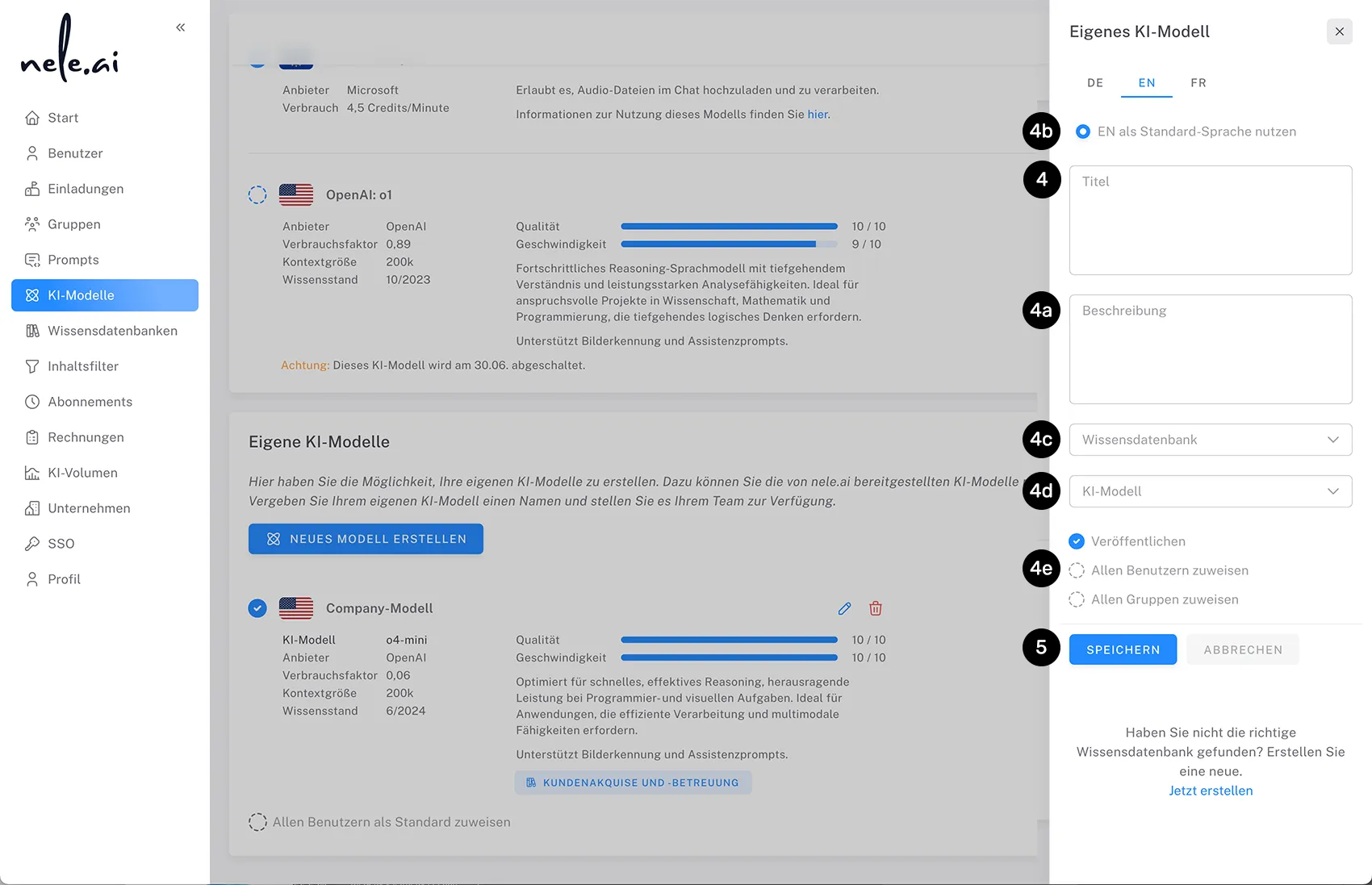
When creating a new model, start by giving your model a title (4) and a description (4a).When creating a new model, the first step is to give your model a title and a description
You can maintain multilingual content when entering the title and description. First, select a default language (4b)—English is preselected by default. You can then add titles and descriptions in various languages. The content will be displayed to members in their preferred language if available; otherwise, the default language will be used. To save the model, at least the selected default language must be populated.When entering a title and description, you can maintain multilingual content. First, choose a default language off - by default, English is the default. You can then save the title and description in different languages. The content is displayed to users in their preferred language when available, otherwise the default language is used. To save the model, at least the selected standard language must be maintained.
Next, specify which knowledge base (4c) and which AI model (4d) should be used.Next, determine which knowledge base and with which AI model work is to be done.
Finally, determine whether the model should only be published—making it available to the team—or if it should also be assigned to all members immediately (4e).Finally, determine whether the model should only be published, i.e. made available to the team, or should already be assigned to all users
Confirm your entries by clicking "Save" or cancel the process by clicking "Cancel" (5).Confirm your entries with “Save” or cancel the process with “Cancel”
Special case: Deleting custom descriptionsSpecial case: Delete your own descriptions
If you wish to delete all saved descriptions for a custom AI model, use the delete function in the edit view. This will permanently remove all content in all languages. The sidebar will close automatically after deletion.If you want to delete all stored descriptions of your own AI model, use the delete function in the edit view. This completely removes all content in all languages. After deletion, the sidebar is automatically closed.
Special case: discontinued custom AI modelsSpecial case switched off own AI models
This case is explained in more detail in the following section, "Model availability and deactivated models"“Model availability and deactivated models”.This case is discussed in the following section, , explained in more detail.
Model availability and discontinued modelsModel availability and discontinued models

The list of AI models available in nele.ai is constantly being updated and expanded with new models.The list of AI models available in nele.ai is constantly being adapted and expanded with new available models.
The availability of some AI models is limited, meaning they can only be used until a certain date. If such a date is set, it will be indicated in the model's description column (1).The availability of some AI models is limited in time, which means that they can only be used up to a certain date. If such a date is fixed, it is identified by a note in the description column of the model
If an AI model is no longer available, it will remain visible in the model list—marked with a corresponding notice—but can no longer be activated by the member. If a significant amount of time has passed since the discontinuation date, the model will eventually disappear from the list.If an AI model is no longer available, it will continue to be shown in the list of models - marked with a corresponding message - but can no longer be activated by the user. If the shutdown date is long ago, the model finally disappears from the list.
Discontinued custom AI modelsDisconnected own AI models
If a custom model contains an AI model that has been discontinued, it will no longer be usable from the moment of discontinuation. This is indicated to the member by a red status icon.If your own model includes a deactivated AI model, it can no longer be used from the time it is switched off. This is signaled to the user by a red status icon.
To reactivate your custom model, you must link it to another currently available AI model. To do this, click the pencil icon, select an appropriate entry from the "AI model" dropdown menu, and confirm by clicking "Update."To reactivate your own model, it must be linked to another, currently available AI model. To do this, click on the pencil icon and select a corresponding entry from the “AI model” selection field. Finally, confirm with “Refresh.”